Driving Creek is well known in Aotearoa and abroad as a place where pottery, art, railway engineering and conservation converge. This unique fusion reflects the passions of Driving Creek’s founder, Barry Brickell. Barry’s individuality and determination attracted a like-minded community in the early days. After more than fifty years, Driving Creek and its inseparable communities continue to grow and evolve, shaped by Barry’s legacy.
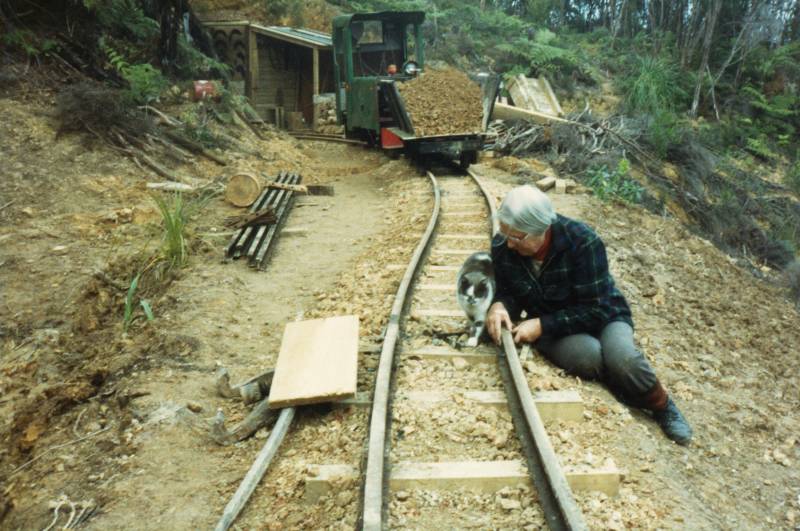
In 1961, aged 25, Barry Brickell left the Auckland suburbs for Kapanga, Coromandel Town, on the opposite side of the Hauraki Gulf. As a young geology graduate and potter, Barry recognised the potential of the Coromandel’s volcanic soils for good clays and raw materials. Coromandel was a place where he could explore his passions for pottery, native ecology and trains. He built a miniature railway around his first home on Driving Creek Road using salvaged rail. Part functional, mostly fun, the rail was used to transport clay and fuel for his kilns. Barry’s passions eventually outgrew his first property and, in 1973, he bought 60 acres of regenerating farmland next door and began the task of relocating and reimagining his pottery and railway. And so began Driving Creek.
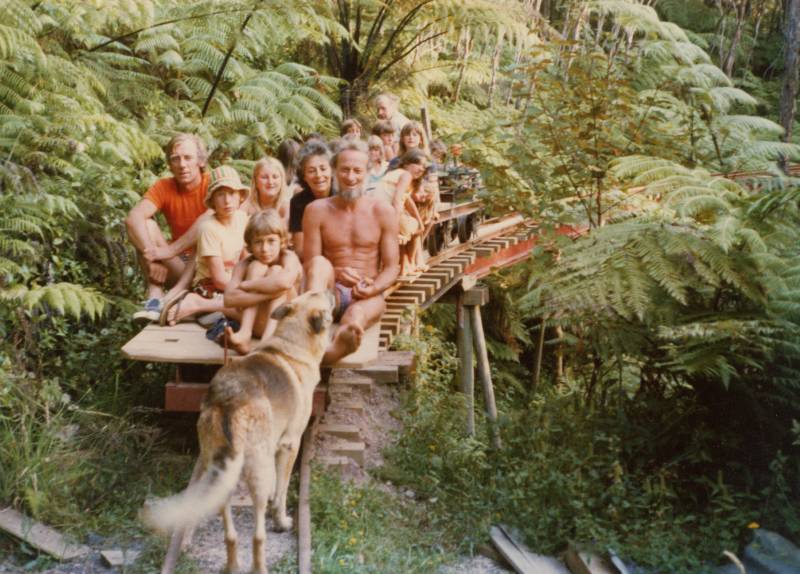
Having invested all his savings into purchasing the land, Barry needed to apply for funding to build the pottery infrastructure. Reclusive by nature, Barry later acknowledged: “If I had students here to teach pottery to, they would look more favourably on my application.” After the funding was granted, young potters and hippies flocked to the pottery and a burgeoning community took root at Driving Creek. The early pottery members shared food, materials, studio space and accommodation. In exchange, they were expected to help with labour around the pottery and on the railway.
Although Barry’s lifestyle and many of his ideals aligned with the back-to-the-land movement of the early 70s, he did not identify as a “hippie.” He was a relentless worker with a vision. His approach to work and life, and life as work, is captured in one of his favourite sayings: “It is not the thing, but how.” For those drawn to Driving Creek, any romantic notions of life in a pottery community were soon corrected by the realities of hard physical labour. The energy and enthusiasm of the early community members were put to use in realising Barry’s vision. As the pottery took shape, track work and tree planting ensured the railway and native forest grew alongside.
Despite the physical requirements of Driving Creek in the early days, the community continued to grow and evolve. By the late 70s it had grown beyond Barry’s comfort levels. He returned from a three month trip to North America with a renewed vision for the pottery. He became more selective about who joined, prioritising dedicated makers with specific projects over those seeking an alternative lifestyle. This was the first formal incarnation of the residency programme.
This shift laid the groundwork for Driving Creek’s lasting contribution to pottery in Aotearoa and beyond. Over the decades, it has nurtured many of New Zealand’s best-known clay workers, offering studio space, support and collaboration. It has also served as an international hub for pottery, hosting the full spectrum of clay workers, from Bernard Leach and George Sempegala to Jim Leedy and Peter Voulkos, potters working in Pacific traditions and Ngā Kaihanga Uku, the Māori clayworkers collective here in Aotearoa.
Barry was undeniably the driving force behind Driving Creek, but its creation was a collective effort. He had close relationships with the likes of Helen Mason and Yvonne Rust, pivotal figures in the studio pottery movement in Aotearoa, who provided much advice and support in the early days. In 1989 Helen Mason relocated to Driving Creek in her custom-built housebus. Despite being in her mid-seventies and twenty years his senior, she did a lot of the day-to-day caring for Barry and Driving Creek on top of her own pottery practice. Wailin and Tom Elliott, loyal friends of Barry’s, also helped to keep him and the growing business alive for decades.
In 2008, Barry’s vision was formalised with the establishment of the Driving Creek Railway, Arts and Conservation Trust. This created a model whereby the profits from the popular tourism operations helped fund the arts, conservation, and heritage work. Driving Creek continues to provide a significant contribution to the local economy and employs close to forty Coromandel locals.
After Barry’s death in 2016, Driving Creek went through a period of redefinition. A new generation of potters arrived, drawn by Driving Creek’s legacy and determined to keep it alive as a hub for craft and creativity. The pottery landscape in Aotearoa has undergone tectonic shifts since 1973 and we see one of the biggest challenges today as the lack of hands-on training opportunities. We have responded by establishing a production studio and apprenticeship programme, running intensive pottery workshops and re-establishing the residency programme.
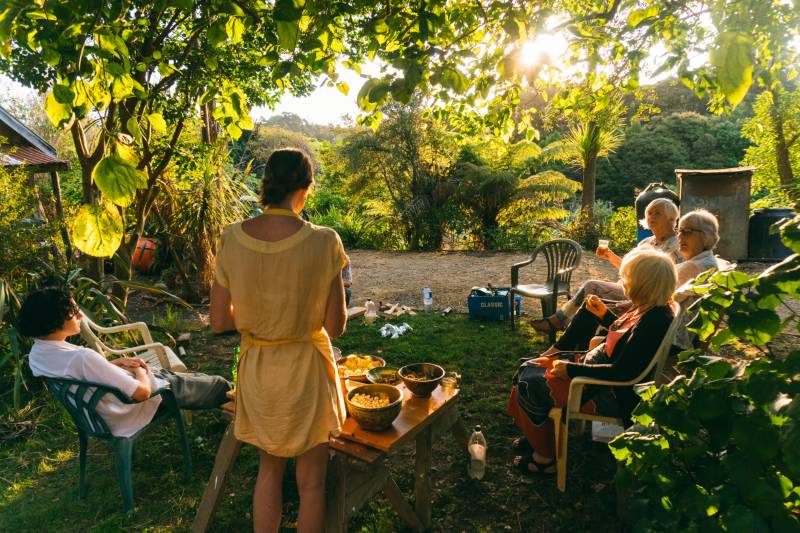
The artist residency programme, relaunched in 2019, is open to creatives working in all mediums at any stage of their creative practice. We host up to sixty residents per year, offering studio space and accommodation in exchange for ten hours’ volunteering per week (it wouldn’t be Driving Creek without a bit of shared labour.) Residents often describe their time at Driving Creek as stepping into a parallel world: where the noise of modern life is drowned out by a strange symphony of diesel locomotives and native birdsong, a place where you can muck in and connect with the elemental process of working with clay.
As a business Driving Creek functions as a symbiotic system: the railway and zipline draw and inform visitors, generating income and sharing the unique Driving Creek story, the pottery studios and residency programme offer opportunities for learning and creative exploration, and the conservation work protects the regenerating native forest. These branches may seem contradictory, but together they form their own living organism. Like Barry’s approach to form in his sculptures: “Combining opposites, almost to the point of absurdity.”
More than fifty years down the track, Driving Creek continues to evolve as a complex ecosystem of clay, rails, native bush and passion. It is the manifestation of Barry’s vision and the labour of the people he brought together: a living community that continues to grow, shape, and be shaped by this place.